I´m passionate about simple models. When I explain heat load analysis, I just tell people: We use energy when it’s too cold or too hot outside. And simple heating-degree-based models (PRISM) or changepoint models are my preferred tools to showcase this.
But we all know that temperature is not the only factor influencing energy loads. Loads are generated so that we are comfortable inside buildings. So another issue is that loads vary depending on our presence in the building, and the kind of activities we perform inside. This results in a social behavior that can be traced through daily load profiles and methods to attribute profiles to specific calendar periods.
But all this has already been covered many times in this blog before.
Another relevant factor to consider is that buildings do have a relevant inertia. Heavy construction materials require relevant time to be heated and cooled after all. And this results in inertial features in heat loads in buildings. For instance, morning load peaks tend to be larger on Mondays, and extend a few hours after temperature set-points are met, so that all the thermal mass in buildings is properly heated.
Until now, we did not fully model this in our load modelling approaches, although I did have a previous work with Markel Eguizabal on developing auto regressive models for buildings.
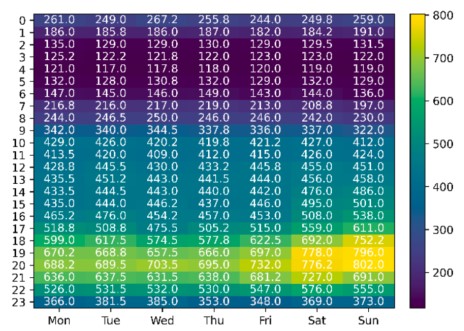
Our colleague Iñigo Lopez faced a need to model the performance of a shopping mall. He needed to be accurate with regards to intra-day performance, and he also had very specific social patterns (we tend to go to the movies on weekend afternoons, see load graph below).
So we decided to build something in between our two previous approaches:
- A time of the week (TOW) approach to model the social behavior
- A regressive approach (ARX) to model the thermal inertia
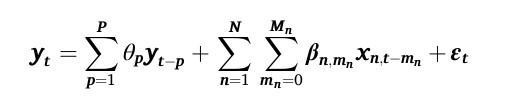
The formula is the one below, and is calibrated with specific values for each time of the week.
The result is interesting, Overall we were able to model the load quite nicely, with MAEs in the range of 20 kW for loads reaching almost 800kW during peak periods.
As it happens quite commonly in these applications, model accuracy was slightly poorer in absolute terms when loads were at the lower end.
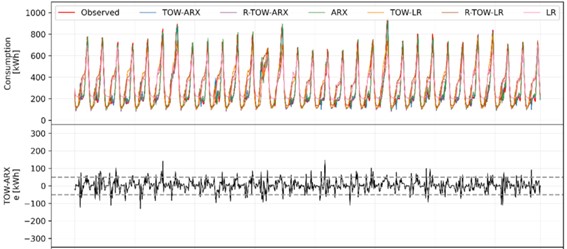
But this can be turned the other-way around. For peak periods, accuracy was in the range of 5% (20kW/800kW), which is quite nice. And if you see the residuals, these are quite stable, without relevant dispersion on prediction quality. So the models are suitable to predict peak loads. And this information can be used to deploy peak shaving strategies.
As always, it has been a pleasure to be invited to this work by Iñigo, Olaia Eguiarte, Beñat Arregi and Antonio Garrido Marijuan. They are fantastic colleagues in our journey throughout building energy modelling approaches.
This work was part of SmartSpin project, and the data was provided by Smarkia.
Anyone willing to read more on this topic, the paper is available open access:
Iñigo Lopez-Villamor, Olaia Eguiarte, Beñat Arregi, Roberto Garay-Martinez, Antonio Garrido-Marijuan, Time of the week AutoRegressive eXogenous (TOW-ARX) model to predict thermal consumption in a large commercial mall, Energy Conversion and Management: X, 2024, 100777, ISSN 2590-1745, https://doi.org/10.1016/j.ecmx.2024.100777