My colleague Mikel Lumbreras has led a fantastic paper that has been published by Energy in January. I´m honoured to co-author this work.
In line with previous and ongoing works, we have developed a regression model that works over frequent data from Heat Meters in District Heating Substations. The model acknowledges that it is expectable to observer variations in heat loads associated to the time of the day and the day of the week. Which can be linked to predictable(?) user behaviour and switches to the thermostat. By doing so, the method improves more traditional energy signature methods (i.e. ASHRAE changepoint).
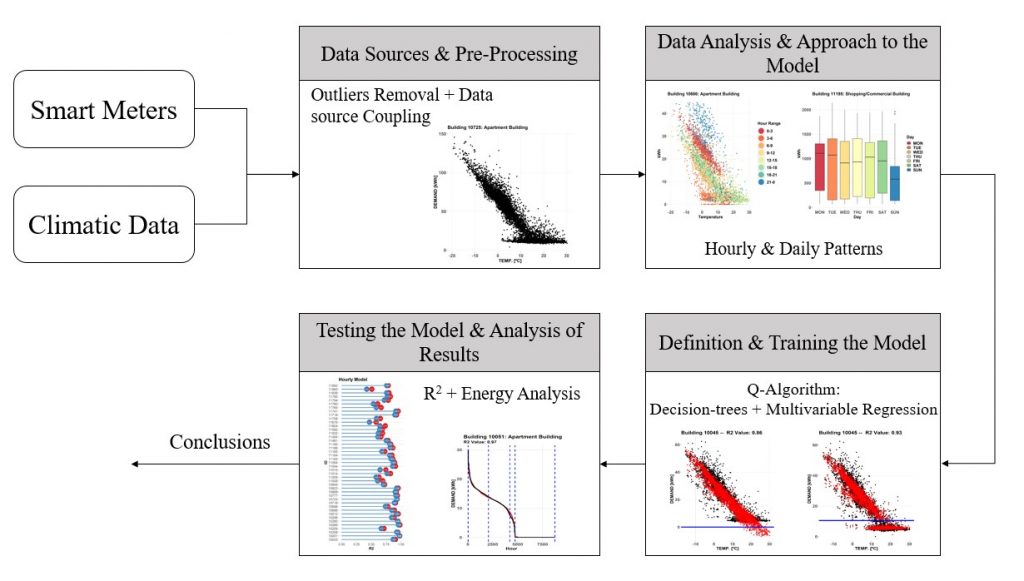
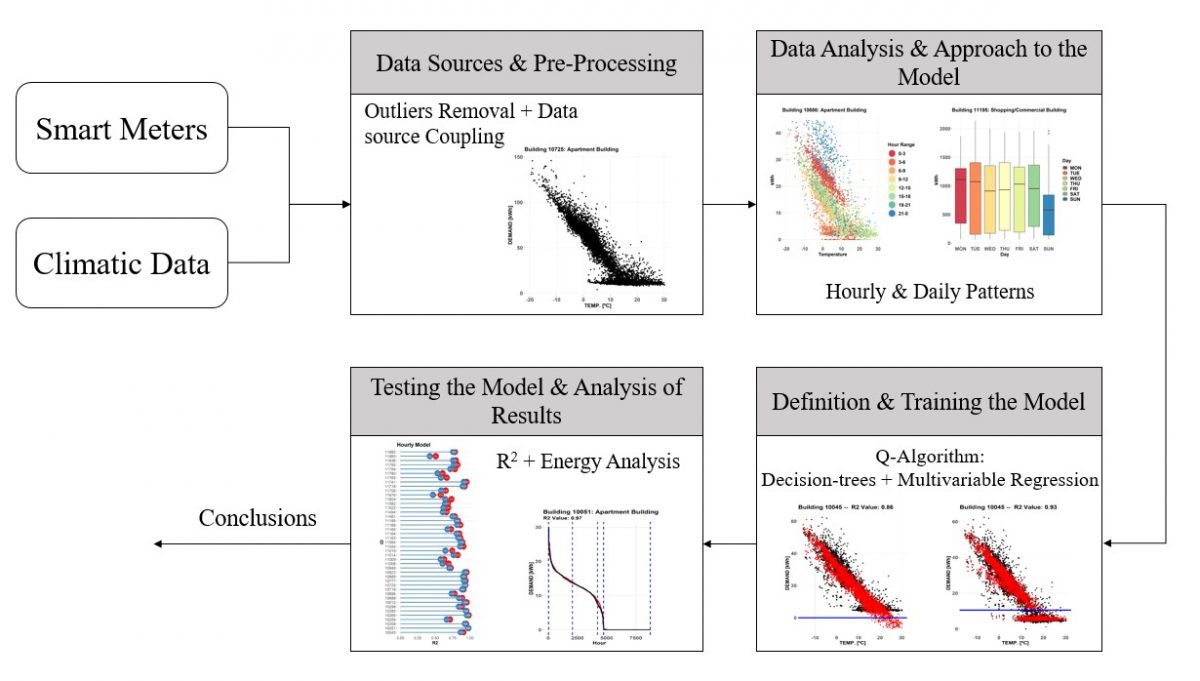
Overall method presented in the paper
It is actually quite in line with previous works such as the one presented in BEYOND2020, but well extended into a full scientific work.
The basic concept is that it is possible to use a linear regression to characterize heat loads in buildings against climate data. But that there is a need to adapt for building users. To do so, data is segmented by the hour of the week and different coefficients are identified for each independent datasets.
Mikel in now trying to improve these methods by selecting typical daily patterns through unsupervised machine learning processes. We already presented some preliminary outcomes in SPLITECH 2021. But there will be a full journal paper on this topic soon.
Overall, the outcomes of the method are quite satisfactory. At least for a relevant share of the buildings. For some others, there is still a need to further refine the method.
The paper is a joint effort of people from the University of the Basque Country, Tecnalia and GREN Eesti. It is available on Open Access in the link below:
Mikel Lumbreras, Roberto Garay-Martinez, Beñat Arregi, Koldobika Martin-Escudero, Gonzalo Diarce, Margus Raud, Indrek Hagu, Data driven model for heat load prediction in buildings connected to District Heating by using smart heat meters, Energy, Volume 239, Part D, 2022, ISSN 0360-5442, https://doi.org/10.1016/j.energy.2021.122318