District Heating keeps warm most of urban areas in cold countries in Europe. It has been so for a while, and there is a substantial need to upgrade these systems to modern energy efficiency and carbon standards. Actually, many cities have achieved large improvements over the last decades and are now close to 3rd or 4th generation temperature levels. And some others are trying to learn from their experiences to improve their systems.
Some days ago, I was invited by Nika Kotovica, from the Riga Energy Agency into an experience exchange group, where people operating the DH network in Lviv (Ukraine) were interested in learning on how Baltic states successfully modernized DH systems from the Soviet Era.
People form Utilitas Tallinn and Vilniaus Silumos Tinklai showed their astonishing progress in modernizing their network over the last 20-30 years. They also presented their District Cooling Networks (Also in Tartu), which are increasingly common even in cold areas such as the Baltic States. I learned a lot on how to define multy-year (probably multi-decade) transition road mapping and the outcomes of wise investments in late 20th century in these cities. I was invited on behalf of Fortum Tartu, who also had a successful transition in the last decades, and is now a landmark example of proficient transition, now operating 95% with renewables & bio-based fuels.
I came in to provide evidence on how we have supported them in supervising temperature reduction processes in the area of Tarkon, where reductions in the range of 15ºC have been achieved in the last 3 years, for a network already operating at relatively low temperature levels. To achieve this, it has been of utmost important their ongoing plan to digitalize energy metering. This has allowed us to scan for low performing areas & substations to improve their performance and ensure that customers are happy and comfortable without noticing that their network is operating at substantially lower & more efficient temperature levels.
Together with my colleagues Mikel Lumbreras, Olaia Eguiarte and Antonio Garrido, we have been working on the heat meter data since 2018 in getting insights on the DH network performed.
We have been able to develop models to develop baseline & forecasting processes for heat load in buildings. This is the basis for the supervision of heat loads in the long term and the calculation of heat losses in the network.
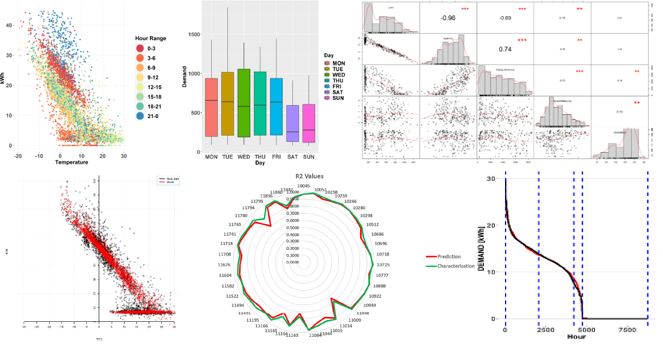
Load assessment & prediction model for building loads based on DH heat meters for buildings in Tartu.
In parallel, detailed data from substations has also allowed us to verify that the DH network is delivering heat at correct temperature levels, and that return temperatures are in line with specifications.
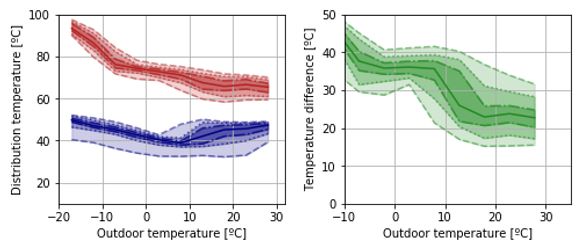
Temperature levels in a (well performing) building DH substation in Tartu.
In this field, one of the key issues is the capacity of substation to meet domestic hot water loads in mild period, when the network operates at low temperature and flow levels.
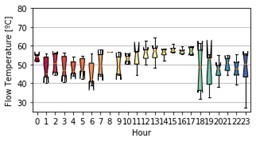
Hourly supply temperature profiles levels during the summer period in a DH branch to be improved.
Our assessments have been able to inform the temperature reduction process, so that limiting items such as control valves and presostatic & thermostatic valves could be upgraded.
After progressive temperature reduction steps since the end of 2019, we will keep supporting Fortum in the temperature reduction with further interventions in summer 2021.
The slides of the presentation are available in this link.
We do already have some of these works published and some others coming:
Mikel Lumbreras, Roberto Garay, Antonio Garrido Marijuan, Energy meters in District-Heating Substations for Heat Consumption Characterization and Prediction Using Machine-Learning Techniques, Beyond 2020, Goteborg, 2020. IOP Conf. Series: Earth and Environmental Science 588 (2020), http://doi.org/10.1088/1755-1315/588/3/032007
Acknowledgements. This project has received funding from the European Union’s Horizon 2020 research and innovation programme under grant agreement No 768567.