As we use energy for many things, heat load data is typically provided in aggregated figures. Typically, the only separation is based on the energy carrier. As there are specific utilities providing each carrier, there are independent data streams for each energy carrier.
But still all heat loads are aggregated within the same load data. Normally Space Heating (SH) and Domestic Hot Water (DHW) production are performed by a single system, either a natural gas boiler, a district heating substation, or a multi-purpose heat pump. In the latter case, even Space Cooling can also be integrated.
This brings out the question on how to assess which part of the load corresponds to each of the sub loads. Historically, SH was the lions’ part of heat loads in buildings, but in the path to de-carbonization (call it building stock retrofitting, Nearly Zero Energy Buildings, Positive Energy Buildings, etc.) SH is reducing its relevance.
It should be considered that SH and DHW loads have substantially different nature, and would potentially benefit from quite different modelling approaches:
- SH is highly correlated with outdoor temperature (the lower the temperature, the higher the load), and may be explicitly activated/deactivated in summer months. There are some intra-daily patterns as we discussed in one of our previous works.
- DHW loads are quite stable all-year-round. Except for holidays, we typically have the same number of showers every year. But there are very relevant intra daily and weekly patterns due to social behavior.
Following previous works, I started conversations with Angelo Zarrella. He also had some ongoing works on data from a District Heating network in Italy. He was particularly interested in developing disaggregation methods for DHW loads. We agreed that this was a problem of mutual interest, and he brought Nicola Borgato (MsC student at that time) into this problem.
Nicola worked hard over the 2022-2023 season, he proved to be an outstanding student, and we developed a method to perform DHW load disaggregation.
Although we keep the idea of Energy Signature Models based on ChangePoint Temperatures, we have identified that this approach is not too suitable to model the behavior on intermediate seasons. And we proposed to change it for a threshold energy level.
The concept is quite simple: If the daily aggregated load is below a specific threshold, we can assume that there is no SH. And everything is DHW load.
Assuming that DHW load is stable all-year-long, the profiles in the summer are used to extract one (or several) intra-day DHW load profiles.
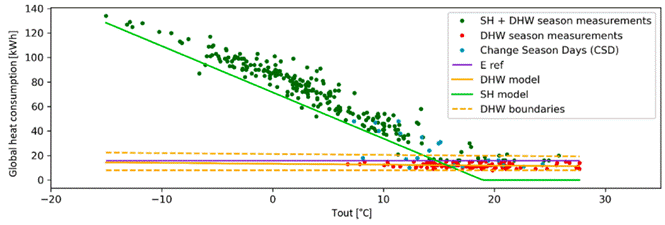
If this load is disaggregated from the total heating load, SH load is obtained. And we propose changepoint models for this load. Equally to some of my other works, individual changepoint models are developed for each hour in the day, so that intra-day variations due to setpoint modifications (i.e. daytime/nighttime changes to thermostats) can be captured.
As a result, the resulting model is able to better capture intermediate season performance, particularly for periods with low instantaneous temperature values on warm days (i.e. nighttime in spring), where thermal inertia in buildings prevents the building for requiring SH.
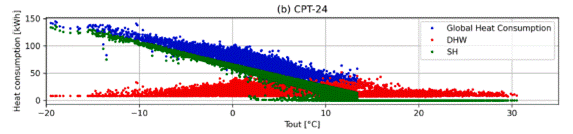
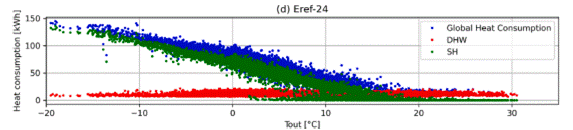
Actually, the devil is in the details, and there are many interesting details in our recently published paper. Particularly, on how model uncertainty is distributed among the SH and DHW models (Eref models clearly outperform CPT models in the figures below). If interested, please have a look.
Overall, I have been extremely lucky to collaborate with Nicola and Angelo in this work. And I hope that there will be other collaborations in the future.
The full paper citation is the following:
Nicola Borgato, Sara Bordignon, Enrico Prataviera, Roberto Garay-Martinez, Angelo Zarrella, Enhanced methodology for disaggregating space heating and domestic hot water heat loads of buildings in district heating networks, Applied Thermal Engineering, 2025, https://doi.org/10.1016/j.applthermaleng.2024.125296