A few months ago, my former colleagues published a retrospective of the Kubik test facility. I feel linked to them and the facility itself as we were office mates, and we developed experiments in the facility for many years. So, I could not resist looking back and commenting.
First, what is Kubik? It’s a full-scale test facility aimed at supporting the development and testing of construction products and energy systems. It is a 3 story-high building, where individual envelope sections can be replaced, internal configurations can be modified, sensors and building automation systems are adapted, and there is a large basement with a large variety of HVAC systems.
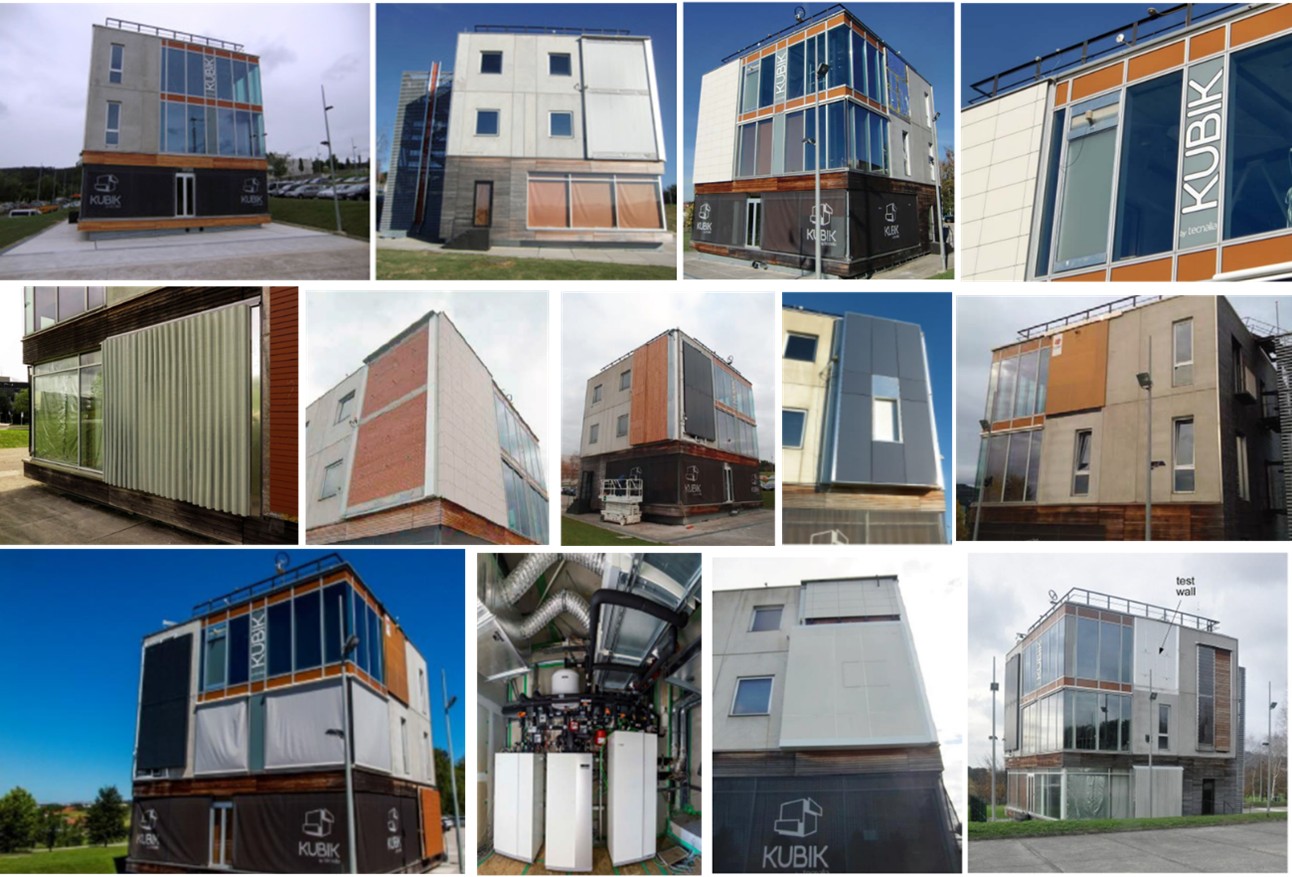
A few general photos of the KUBIK test facility.
I have written other posts about it, and there are several conference papers presenting its rollout and the 5– and 10-year evolution.
With the rollout of the Spanish Technical Building Code (CTE) in 2006, Tecnalia deployed a research aim in Energy in Buildings. Together with existing research in modular/industrialized construction, this formed the backbone of the group where I was hired in 2008 (my first job!). It was a quite large and diverse group (about 20pax with various specializations around Construction, Energy, & ICT), and they were offered the chance (and funds) to dream for a research facility.
At that time, there were not so many research facilities out there. Passys-Paslink test cells (already a 20-year old concept at the time), component-level experiments such as the TRE, and ad-hoc experiments. But there were several ambitions for a new wave of facilities. Very interesting facilities such as VERU, KUBIK, TIPEE, BESTLAB,UCEEB, FACT, Twin Houses, Energy House…appeared in about a decade. A. Janssens, S. Roels & L. Vandaele published a book with many of the facilities out there at the time.
The approach in Kubik is quite unique and different to many of the above-mentioned facilities. Without standardized test environments or procedures, experiments are designed ad-hoc, to best fit the needs of each research project.
The facility was designed in a modular way. And each time, a test is defined, envelope components and internal partitions are dismantled/erected/adapted, HVAC systems adapted, sensors installed, and monitoring and control programme are developed.
This requires a result-oriented, highly motivated, skilled and multidisciplinary team. With some exceptions, we focused on proof of concept and short performance assessment experiments, in between a few months and a year.
When I was part of the team, there were around 6 to 10 projects in the management board at some stage of the experimental process.
The large number of experiments, short measurement campaigns, and varied architectural configurations led to pay strong attention to interactions among components. Understanding these interactions was not only part of the experimental uncertainty assessment but became part of our research aim (i.e. my PhD thesis). And this shaped our experimental approach in a quite unique way.
My colleagues state that since its opening in 2010, more than 70 projects (nobody really has the exact count) have undergone experiments in Kubik, and that the facility has adapted to the incorporation of experiments in complex HVAC, RES, Digital systems for the Management and Operation of buildings, and Indoor Air Quality.
I believe that technology and society have evolved since Kubik opened in 2010. And this has impacted both the performed research, as well as the experimental approaches. Just a few examples:
- After 2 recasts of the building code, Insulation levels have increased substantially, NZEB is our current practice and multi-rise passive-house buildings are being deployed (sometimes with imperfect execution).
- We are phasing-out fossil fuels. Renewables are now common in buildings and heat pumps are established products in Southern Europe, at the core of the electrification trend.
- Building automation is continuously evolving. Advanced monitoring and control products/platforms/services like RESPIRA, SMARKIA, DYSECO, DNERGY,…are increasingly deployed over commercial buildings. NEST or NETATMO, are common in houses, and geeks can build their own systems with Home Assisstant over a RaspberryPi.
- Research priorities are changing towards lower embodied carbon (timber and other bio-based products and low GHG refrigerants), digitalization (BIM, logbooks technical documents), and automation (automated construction).
Change is a continuous process, so similar statements could have been written about the preceding 15 years, or any other time frame.
Even if technologies, approaches, etc. vary, the foundations remain. When developing an experiment, it is key to consistently go through a few steps:
- Understand system to be experimented & set experimental goals
- Develop a performance model for the system & an experimental approach that maximize the likelihood of observing the desired performance
- Check viability of the experiment in the facility (i.e. space, constructability, interactions with other experiments, HVAC & data connections…, timing)
- Construct & commission
- Experimentation & Data analysis
All the steps are critical. Over time, we found cases where only step 4 was considered, and very little time allowed for step 5. This obviously led to failure. On the other hand, following the full process resulted in better focused, cheaper, and more successful experiments.
The success of Kubik is largely linked to a highly motivated, skilled and multidisciplinary team. My feeling is that it is very difficult to set such teams and stabilize them in time. Tecnalia succeeded in doing so, although this is a never-ending process.
What comes next? Nobody knows. I am now applying my experimental background mostly to data streams coming from real-life buildings. That solves research on operational performance. But there is still a need for experimental facilities to deal with more fundamental research. Whatever comes next, the path will be interesting. As it was during the last 15 years.
If you want to read about this, you can find the reference below:
- Elguezabal P, Alvarez-Alava I, San Mateos R, San-Jose-Lombera J, Chica Páez JA, «Reflections and lessons after 15 years and over 70 R&D projects in KUBIK, an adaptable test bed building for constructive technologies». Open House International, 2025, https://doi.org/10.1108/OHI-02-2025-0079
Also, some time ago, we spend some time discussing on how a research facility should be designed, staffed, operated… within project RIEEB:
- RIEEB, Research Infrastructures on Energy Efficiency in Buildings, https://cordis.europa.eu/project/id/262476