
I was introduced to Riccardo Gazzin about a year ago. He was quite a smart engineer trying to redefine performance assessment methods for glazed envelopes. Particularly interested in understanding how accurate these methods are, and in developing shorter experimental methods.
We had a couple of meetings with his supervisors at EURAC (Miren Juaristi, Giuseppe De Michele) and University of Bolzano (Giovanni Pernigotto, Andrea Gasparella), and found that my previous work on uncertainty assessment could be an starting point for this.
So he came to Deusto at the beginning of 2025 to work on the redefinition experimental methods to determine U-value and g-values. Our results on in-situ characterization of U-value through the Heat Flux Method are already published.
In this work, we are revisiting ISO 9869-1, quite an old, well known and robust experimental and data analysis procedure to experimentally assess U-values. With some variations, this is the starting point of many research works (i.e. my own PhD thesis).
But we felt that it was not so suitable for glazed envelopes. Basically, because of two reasons:
- It is designed for inertial walls. Accordingly, it prescribes quite extensive experimental campaigns
- Data analysis procedures are based on cumulative processes to reduce the effect of inertial effects and allow for easy computation.
Even if the standard has some alternative methods for “lightweight” envelopes (i.e. timber frame), it is still not totally suited for extremely light systems such as glazed envelopes.
Se we proposed a new approach, which inherits the physical setup of ISO 9869-1, and takes inspiration of the “lightweight” approach but it goes further in some aspects:
- It is known that solar irradiation disturbs temperature and heat flux measurements. This is particularly relevant in the case of glazed envelopes, where solar radiation impacts differentially over surface sensors (opaque) with regards to glass (transparent). We approach this by considering only night-time measurements.
- Thermal inertia in glass is known to be very reduced. We take advantage of this and consider that many independent observations can be made in a very short period (i.e. the same night). Also, thermal accumulation is neglectable sometime after sunset.
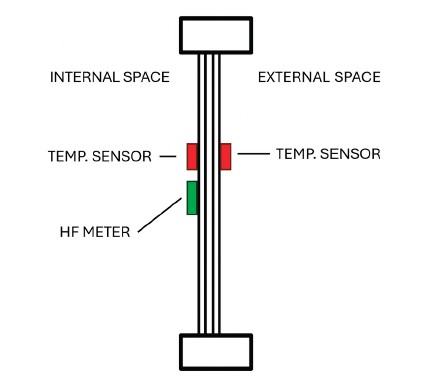
Experimental setup. Source: Gazzin et Al.
He made quite a detailed uncertainty analysis, considering typical measurement errors. To do this, the basic idea is that you should derive the thermal transmittance formula against all possible sources of uncertainty, multiply by the corresponding uncertainty, and add all the results together.
We considered this, together with typical winter conditions in mild climates, aiming at a 1-night measurement campaign.
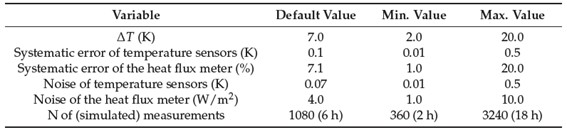
Individual sources of error in thermal conductance formulae, Source: Gazzin et Al.
We found that a one-night measurement campaign had an equivalent uncertainty to ISO 9869-1 (about 14%) for glazed components in the range of 1 W/m2K with indoor-outdoor temperature differences in the range of 5ºC. No great difference was observed after one night of measurements.
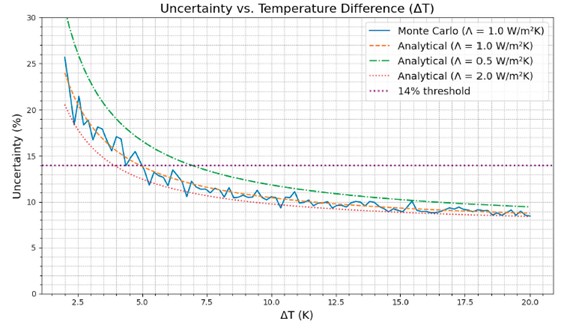
The result is interesting, as it showcases the possibility of performing thermal conductance measurements of glazed components in only one night, given that the night is sufficiently cold. Our uncertainty determination process is quite sound, and provides a robust alternative approach to the existing standard, with substantially shorter measurement campaigns.
This work is a joint effort of Riccardo Gazzin, Giuseppe De Michele, Giovanni Pernigotto, Andrea Gasparella and myself. It is more advanced than what I presented here. If you are interested, please have a look to the original work:
Gazzin, R., De Michele, G., Pernigotto, G., Gasparella, A., & Garay-Martinez, R. Sensitivity Analysis of the Uncertainty of the Heat-Flux Method for In-Situ Thermal Conductance Assessment in Glazed Façades. Buildings, 2025, https://doi.org/10.3390/buildings15193504
Riccardo should also submit his PhD thesis soon, with even more advanced methods (to be published as separate papers some day).